by Kim Winter, Founder Group Managing Director Logistics Executive
Lead
Global supply networks have been shaken by pandemic disruptions, the climate crisis, geopolitical realignments and shifting consumer expectations. After several years spent building resilience and visibility, supply‑chain leaders now face a new imperative: sustainability. Legislators in Europe and North America are requiring companies to report emissions across their value chains, investors are pressuring firms to cut waste and carbon, and customers are rewarding businesses that demonstrate ethical sourcing and circularity. The shift demands granular knowledge of costs and environmental impacts across every node of a network. At the same time, a fresh wave of digital technologies promises to transform planning, sourcing, making and moving goods. Among these technologies, generative artificial intelligence (GenAI) has seized attention for its ability to synthesis vast datasets, generate new content and recommendations, and learn from feedback. Early use cases suggest that GenAI could streamline procurement, route planning and supplier management. Yet deploying a technology that relies on enormous computing resources also raises concerns about energy and water use. This article examines how Gen AI is being applied to build sustainable supply chains, the benefits demonstrated in current pilots and the challenges companies must address to ensure that AI’s environmental footprint does not outweigh its gains.
The supply chain sustainability imperative
Supply chains are responsible for the majority of many companies’ greenhouse‑gas emissions and natural‑resource use. Recent regulations such as the European Union’s Corporate Sustainability Reporting Directive (CSRD) and the U.S. Securities and Exchange Commission’s proposed climate‑disclosure rules require firms to account for Scope 3 emissions, the carbon generated in upstream procurement and downstream distribution. According to KPMG, supply‑chain leaders in 2025 must deliver genuine value by deeply understanding the cost implications of different products, customers and channels, and by evaluating the environmental and social practices of their suppliers [4]. New laws and stakeholder demands are making sustainability a strategic differentiator rather than an afterthought. To meet this challenge, organisations need data‑driven insights into the carbon intensity of logistics, production and materials, along with tools to design greener networks and measure progress in real time.
What is generative AI, and why does it matter?
Artificial intelligence has been used for years to predict demand, optimise inventory and manage procurement. Generative AI refers to a subset of AI that does more than classify or predict: it generates new content or scenarios based on the patterns it learnt. Large language models (LLMs) like ChatGPT can produce human‑like text; diffusion models create synthetic images; and increasingly, domain‑specific models output code, designs or forecasts. GenAI can ingest structured and unstructured data, sales histories, weather forecasts, supplier audits and ESG reports and generate summaries, risk scenarios or recommended actions. According to EY, around 62% of supply chain organisations already use AI for sustainability tracking and measurement, and 40% are investing in generative AI. With improved user interfaces and the ability to chat in natural language, GenAI tools make advanced analytics more accessible across planning, sourcing, manufacturing and logistics.
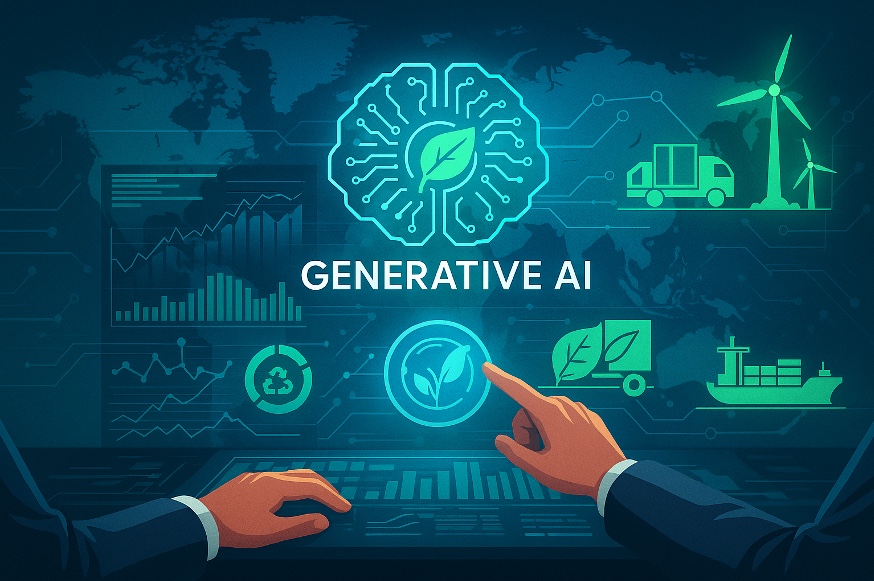
How generative AI is transforming sustainable supply chains
Route and freight optimisation
Inefficiencies in transportation from half‑empty trucks to congested ports add up to higher emissions and costs. An article by logistics platform GoComet describes how generative AI analyses real‑time conditions and dynamically reroutes shipments, preventing waste before it occurs. Rather than following fixed schedules, AI‑driven systems generate “smart, adaptive paths” that adjust to traffic, fuel prices and weather. Businesses that have implemented AI‑driven route optimisation report up to a 10% reduction in fuel consumption , leading to lower transportation costs and fewer emissions. Ocean‑freight scheduling algorithms ensure that ships arrive when ports are less congested, avoiding idle time that burns unnecessary fuel.
GenAI also tackles one of logistics’ biggest inefficiencies: empty miles. By analysing shipment patterns and running multiple load‑consolidation scenarios, the technology identifies opportunities to combine compatible shipments and maximise space utilisation. Fewer trips mean lower fuel use and reduced strain on supply chains. In addition, predictive tools simulate disruptions (from weather or geopolitical crises) and suggest proactive adjustments. During the Red Sea crisis of 2023–24, a global textile manufacturer used GoComet’s predictive estimated time of arrival (ETA) to align production with delayed shipments, preventing downtime and expensive last‑minute air freight.
Demand forecasting and inventory optimisation
Accurate demand forecasting is essential for minimising waste. Traditional models often miss complex patterns, leading to overproduction or stockouts. Generative AI models can consider historical sales, market trends and external factors simultaneously. They “model various situations and generate analyses” so businesses can explore diverse scenarios and adjust production accordingly. Microsoft’s Dynamics 365 Copilot uses the Azure OpenAI Service to predict disruptions across suppliers and geography, identify external risks and recommend actions. Early adopters achieved a 90% return on investment within three years and improved operational efficiency by US$1.5 million. Domino’s Pizza UK & Ireland automated demand prediction using AI and analytics, improving its forecasting accuracy and moving away from error‑prone spreadsheets.
GenAI also optimises inventory levels and warehouse operations. By forecasting ideal stock based on demand trends and external factors, AI helps businesses avoid overstocking while preventing shortages. In warehouses, the technology can optimise layouts and automate energy use, making operations greener and more cost‑effective.
Supplier selection and vendor negotiation
Selecting suppliers solely on cost no longer suffices. GenAI tools evaluate partners based on carbon footprint, labour practices and energy efficiency. GoComet notes that AI dives into data‑driven insights to help companies choose suppliers who align with environmental goals without sacrificing reliability or cost. Deloitte’s Tore Christian Jensen argues that GenAI provides real‑time insights into ethical practices of suppliers, allowing businesses to track the origins of raw materials and ensure responsible procurement. This capability helps companies meet CSRD requirements and build trust with stakeholders.
Generative AI is even entering negotiations. EY reports that a leading US retailer and a European container shipping company use GenAI‑powered bots to negotiate purchasing terms with suppliers, reducing costs and structuring complex tender processes. When surveyed, over 65% of vendors preferred negotiating with the AI bot rather than with company employees. Natural‑language processing can extract key information from large contracts, highlight risks and suggest renewal strategies.
Manufacturing and predictive maintenance
In the manufacturing sector, GenAI accelerates product design by rapidly generating and evaluating hundreds of alternative configurations based on predefined criteria. Engineers can use AI‑generated designs to improve the efficiency, durability or sustainability of parts. Predictive maintenance models learn from machine data to create maintenance schedules that align with likely failure times, reducing downtime and extending equipment life. EY notes that a leading industrial manufacturing company partnered with a technology vendor to use GenAI for factory automation, shortening product development cycles and boosting efficiency. Master of Code’s analysis describes predictive maintenance as a major opportunity, enabling manufacturers to anticipate equipment failures and reduce costs.
Logistics and last‑mile delivery
AI‑enhanced logistics extend beyond route optimisation. In warehouses, GenAI platforms can optimise picking routes, boosting workforce productivity by about 30% and reducing operational costs. For global trade, the technology analyses variables such as tariffs, customs regulations and shipping costs to recommend the most efficient and compliant routes [29]. GenAI can design logistics networks by choosing optimal warehouse locations and transport links and continuously update last‑mile delivery routes based on traffic, weather or delivery priorities.
Transparency and ESG reporting
A growing body of regulation requires companies to demonstrate that their supply chains meet environmental and social standards. Deloitte explains that GenAI “equips companies to meet these new standards by providing real‑time insights into the ethical practices of suppliers” and enabling them to track origins of raw materials with verifiable data. Companies can evaluate suppliers’ sustainability practices, ensure responsible procurement and align with ESG goals. GenAI thus transforms sustainability from a long‑term aspiration into an operational reality.
Business benefits and early results
Early adopters report tangible benefits from AI‑enabled supply chains. GoComet notes that companies adopting AI‑powered sustainable logistics reduced logistics expenses by 15%, lowered stock levels by 35% and improved service efficiency by 65% compared with businesses using traditional methods. These gains illustrate how sustainability and efficiency can be mutually reinforcing. Other benefits include:
- Cost savings – AI‑driven route optimisation cuts fuel consumption, smarter inventory forecasting reduces warehousing expenses, and automated energy management lowers operational costs.
- Regulatory compliance – AI tracking of real‑time emissions, route optimisation and automated reporting simplifies adherence to carbon‑emission standards.
- Brand value and customer demand – Strong sustainability initiatives attract investors, business partners and talent. Consumers increasingly prefer eco‑conscious brands, and AI‑powered transparency builds trust.
- Risk mitigation – GenAI can simulate disruptions and propose contingency plans, helping companies avoid expensive surprises. EY highlights that AI‑generated risk assessments and scenario simulations help planners manage risks proactively.
Challenges and environmental concerns
Computational footprint
The excitement surrounding GenAI often overlooks its environmental cost. Yale Environment 360 reports that the rapid deployment of generative AI requires massive amounts of energy for computation and data storage and millions of gallons of water to cool the equipment at data centres. A session of roughly 10–50 interactions with GPT‑3 may consume around half a litre of fresh water due to cooling requirements Globally, data centres consumed an estimated 1,000 terawatt‑hours of electricity in 2026, about twice their consumption in 2022 and roughly equal to Japan’s total electricity use. Much of this demand is driven by cloud facilities that host AI models. Google and Microsoft disclosed that their data centres’ water use increased by 20% and 34%, respectively, in 2022. In some regions, proposed data centres have sparked protests over the extraction of drinking‑water reserves.
Data quality, bias and ethical risks
GenAI’s outputs are only as reliable as its inputs. EY warns that generative tools are limited by the quality and availability of data from supply‑chain partners. If supplier emissions data are incomplete or inaccurate, an AI‑driven sourcing recommendation could inadvertently favour polluting producers. Natural‑language models may inherit biases present in training data, potentially reinforcing inequities in supplier selection or labour practices. Strong governance, transparent data‑sharing agreements and human oversight are necessary to mitigate these risks.
Governance and regulation
Policymakers are starting to scrutinise AI’s environmental and social impacts. In Washington, Senator Edward Markey noted that “the development of the next generation of AI tools cannot come at the expense of the health of our planet” and introduced legislation requiring the U.S. government to assess AI’s environmental footprint. The European Union’s AI Act will require high‑risk AI systems, including generative models used in supply chains, to report their energy consumption, resource use and lifecycle impacts. At the international level, the International Organisation for Standardisation plans to issue criteria for “sustainable AI”, covering energy efficiency, raw material use and water consumption. Companies deploying GenAI should anticipate stricter disclosure requirements and incorporate environmental metrics into their AI strategies.
Future outlook: integrating AI and sustainability
Delivering genuine value by 2025
KPMG predicts that in 2025, supply chain leaders will finally start to derive genuine value from GenAI investments. The technology can streamline tasks in procurement, category management, contract management, supplier risk analysis and invoice processing. As digital twins become more prevalent, leaders will have real‑time visibility into supply networks and can simulate changes before implementing them. The consultancy emphasises that leaders must not only leverage technology but also adopt new cost‑to‑serve analytics, deepen visibility into Tier‑4 suppliers and collaborate across ecosystems. Digital twins and predictive planning will help map supply chains, identify carbon hotspots and guide decarbonisation strategies.
Human–AI collaboration and new skills
Deloitte notes that GenAI isn’t just a tech upgrade; it is a pivotal technology reshaping how companies build efficient, resilient and sustainable supply chains. Real‑time data insights can predict disruptions before they happen, AI‑driven automation reduces costs and carbon emissions, and advanced analytics turn sustainability from a goal into an operational reality. However, realising these benefits requires new skills and organisational structures. KPMG expects supply chain and procurement personnel to upskill in data analysis and AI modelling, while companies open global capability centres to leverage talent pools. EY adds that GenAI will act as a “multiplier” in what humans and technology can achieve together, enhancing planning, sourcing, manufacturing and logistics.
Balancing AI’s benefits and footprint
The paradox of AI in sustainability is that it can both reduce and increase environmental impacts. On the one hand, AI‑optimised smart homes could reduce household CO₂ consumption by up to 40%, and AI‑guided flight paths could cut aviation contrails. On the other hand, the rebound effect of increased usage because of efficiency gains may offset some of the benefits. To ensure net positive outcomes, supply‑chain leaders should:
- Set dual goals – Evaluate AI projects on their ability to reduce emissions and resource use as well as improve efficiency and profitability. Establish key performance indicators (KPIs) that track carbon intensity and water consumption alongside cost savings.
- Invest in green infrastructure – Prioritise data centres powered by renewable energy and cooling systems that minimise water use. Cloud providers are beginning to publish sustainability dashboards; companies should integrate these metrics into AI procurement decisions.
- Promote transparency – Participate in industry initiatives to standardise reporting of AI’s environmental footprint. Share data with regulators, investors and the public to build trust and meet emerging compliance obligations.
- Develop responsible AI governance – Adopt frameworks that address data quality, bias, privacy and accountability. Include diverse stakeholders in AI development and use independent audits to identify unintended consequences.
- Upskill and reskill workforce – Provide training in AI literacy, sustainability metrics and ethical decision‑making. Encourage collaboration between data scientists, sustainability experts and supply‑chain managers.
Conclusion
The convergence of sustainability pressures and rapid advances in artificial intelligence is reshaping global supply chains. Generative AI offers powerful tools to optimise routes, consolidate loads, forecast demand, design products, maintain equipment and manage suppliers. Pilot projects show that AI‑enabled supply chains can reduce emissions and costs simultaneously [34]. Analysts expect genuine value to emerge by 2025 as organisations move from experimentation to deployment. Yet the technology’s computational hunger threatens to undermine its sustainability promise: data centres consume enormous amounts of electricity and water, and the rebound effect could erode efficiency gains. The future of sustainable supply chains therefore hinges on responsible adoption. Businesses must pair GenAI implementation with transparent reporting, green infrastructure, robust governance and continuous upskilling. With these safeguards in place, generative AI could become a cornerstone of supply‑chain decarbonisation, turning sustainability from a reporting requirement into a source of competitive advantage and resilience.
About the Author

Kim Winter E-Commerce Editor at CargoNOW Logistics Partnerships Director at AfterShip, Global eCommerce Logistics Expert