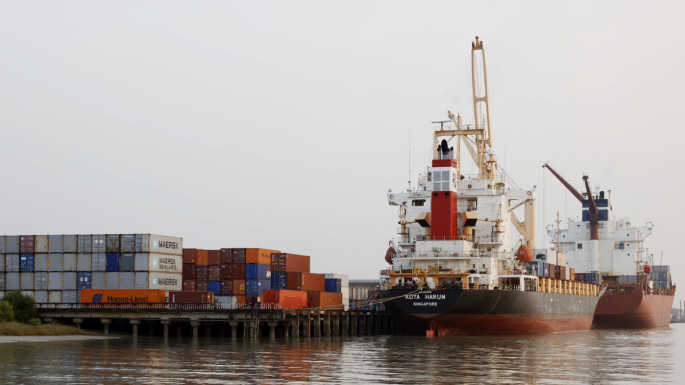
Beijing has finalised a $336 million concessional loan agreement through the Export-Import Bank of China to expand Bangladesh’s Mongla Port. Executed by China Civil Engineering Construction Corporation (CCECC), the contract delivers two new container terminals, dedicated container yards and modern cargo-handling equipment, adding 394,000 TEUs in annual container capacity.
Combined with the Chinese-built Padma Bridge, which slashes road transit times between southwestern Bangladesh and Dhaka, this upgrade represents a major Belt and Road Initiative (BRI) infrastructure milestone in the Bay of Bengal.
While regional headlines have centered on geopolitical maneuvering between China and India, the project carries direct operational consequences for Southeast Asia’s maritime transshipment hubs such as Singapore’s next-generation Tuas Port.
The Spoke-and-Hub Reality: Bangladesh Relies on Feeder Corridors
Mongla is not a direct rival to Singapore’s transshipment business. It is a gateway spoke. River draft constraints in Bangladesh prevent ultra-large container vessels (ULCVs) from making direct mainline port calls. Consequently, Bangladesh’s containerised trade, anchored by its massive ready-made garments (RMG) export industry must move via regional feeder networks to major hubs before connecting to long-haul trades serving Europe, North America, and East Asia.
Historically, this feeder traffic has been divided between Colombo, Singapore, Port Klang, and Tanjung Pelepas (PTP). Adding nearly 400,000 TEUs of handling capacity at Mongla injects fresh cargo flows into the Bay of Bengal corridor. The question for regional trade planners is straightforward: Which transshipment hub will capture this volume?
The Strategic Ripple Effect on Tuas Port
As Singapore consolidates its container terminals into Tuas Port, building toward an eventual 65-million TEU annual capacity, the facility cannot thrive purely on legacy mainline East-West container exchanges. Its long-term economic justification depends on acting as the central aggregation hub for high-growth regional feeder spokes.
China’s expansion of Mongla interacts with Singapore’s maritime network across three major dimensions:
- Intensifying Feeder Competition with Malaysia: While Colombo captures Suez-bound transshipment due to proximity, the Malacca Strait remains the primary conduit for Trans-Pacific and intra-Asia freight. With Port Klang and PTP commanding a combined volume exceeding 30 million TEUs and aggressive terminal handling rates, Malaysian quays represent an immediate alternative for Bangladeshi feeder traffic. If Singapore does not offer competitive turnaround times and friction-free feeder connectivity, these new flows will bypass Tuas entirely.
- Carrier Alliances vs. BRI Alignments: As Chinese state-owned enterprises construct and finance Mongla, routing dynamics could shift. Chinese state-backed carriers, such as COSCO Shipping and its Ocean Alliance partners, may optimise feeder services toward Chinese-invested hubs across the Indian Ocean or dedicated regional nodes. Retaining these volumes requires Singapore to deliver digital, customs, and operational efficiencies that outweigh state-led infrastructure alignments.
- Stabilising Feeder Schedules and Berth Productivity: Chronic congestion at Chattogram has historically caused vessel bunching and unpredictable delays across Southeast Asian ports. By absorbing export volumes and providing faster transit via the Padma Bridge, a modernised Mongla stabilises feeder schedules. For Tuas Port’s automated yard cranes and AI scheduling engines, smoother feeder arrivals mean predictable berth allocations and maximised terminal productivity.
Threat or Opportunity? The Industry Verdict
Rather than viewing China’s port investments along the Indian Ocean with apprehension, the maritime and logistics sector sees an opening—provided national policy pivots from administrative control to commercial aggression.
“Every time China finances a regional port expansion or an emerging market adds quay capacity, the default reaction among policymakers is to view it defensively as an encroaching threat,” explains Dr. Raymon Krishnan, President of The Logistics & Supply Chain Management Society (LSCMS). “That is a legacy landlord-port mentality. Mongla’s expansion is not taking cargo away from Singapore. It is injecting hundreds of thousands of new containerised flows into the regional trade pipeline. If the powers that be wake up to the reality of modern supply chain orchestration, this is an immense commercial opportunity. Tuas Port has the physical hardware and automated muscle but unless we moves beyond modal silos to actively integrate with regional 3PLs and Beneficial Cargo Owners, those feeder volumes will simply default to our competitors across the Causeway.”
The Supply Chain Takeaway
China’s financing of Mongla Port highlights the ongoing decentralisation of Asian manufacturing and logistics infrastructure. For Singapore, throughput volume will not materialise purely by virtue of geographic history.
If Tuas Port is to serve as an indispensable regional trade buffer rather than an underutilised mega-terminal, Singapore must actively capture these emerging South Asian feeder corridors. That requires commercial agility, rapid feeder vessel turnaround and direct collaboration with the regional practitioner networks driving global trade.