by Charles H.W. Edwards, Vice President at SASI World, Inc., and Hart Brown, CEO at Future Point of View
The worldwide air cargo logistics industry continues to experience disruptions which change the intersection between the service providers and the consumers, otherwise known as the beneficial cargo owners. The complexity of cross-border air cargo flows, involving as many as thirty-nine steps, as well as the numerous changes of operations, services, regulations, and processes underscores the need for new tools. Synthetic (AI) and machine intelligence (human-centric robotics) have reached a level that encompasses a set of solutions, such as new reasoning models, AI agents, and ‘world’ models that can be leveraged to create new services and system solutions. These various solutions are not disrupters, rather they are enablers critical to the smooth function of a very complex system.
The challenge is to understand how synthetic and machine Intelligence and their integration into the worldwide air cargo logistics industry; can benefit cross-border supply chain.
In a 2024 paper, A.P. Moller–Maersk noted that the world economy is in “Industry 5.0,” in which synthetic intelligence (AI), the Internet of Things (IoT), and machine intelligence (human-centric robotics) are being integrated with the aim of developing resilient, adaptable, and more efficient production systems. This development is revolutionising supply chain operations and management leading to better connectivity and flexibility. In just one example, a study of the use of AI in the logistics industry highlighted route optimisation, greenhouse gas emission and management, and transportation management system integration.
When analysing use cases through a technology development lens, it becomes very clear that organisations that make up the worldwide air cargo logistics industry will need to heavily collaborate to establish the necessary reliability, transparency, efficiency, and margin creation, that the business environment is increasingly demanding. There is a massive potential of leveraging synthetic and machine intelligence to solve the growing list of challenges that cause friction between the movement of the consignments and the associated information. Achieving this potential will only be realised when data standards are created and enforced, data flow is enhanced, and a set of AI tools is created that can span across the air cargo logistics ecosystem.
Improved supply chain visibility is a strategic priority for supply chain managers. Managers need to rapidly adapt to frequent disruptions and system changes. In turn the members of the worldwide air cargo logistics industry must respond quickly to avoid the reactionary ‘learning by surprise’ process and maintain the resilience and sustainability of their operations and services. Instead of waiting for an event to occur, members of the worldwide air cargo logistics industry need to change their business focus from transactional relationships to long-term collaboration with other members of the worldwide air cargo logistics industry and the beneficial cargo owners. This fundamental change requires the collection of a wide array of data and information, and the application of synthetic intelligence (AI) to identify trends, devise tactical options, and create long-term future-proofed programs.
As shown in the following figure, the environmental (business and geopolitical) uncertainty stresses existing supply chains and forces change at increasingly high frequency levels and emphasises a focus on collaborative business relationships. The entry of new competitors and new services, underscore changes in market strategy, creating innovative products that involve higher levels of managed risk and a high level of service—operations coordination. Facilitating these processes is technological turbulence that is taking place concurrently. The creation of new tools is based on the commitment to collect and share consignment data and information in a controlled and protected environment. Data and information governance is a critical step. With access to appropriate data, intelligent tools can be created in a collaborative environment. The increased volumes and more diverse consignment details will require synthetic intelligent (AI) tools to assist human managers as they deal with the constant operational changes and create new supply chain structures, market strategies, and new product portfolios. The core process will create innovative short- and long-term solutions. All this change requires that traditional silos be demolished.
Employing AI to Address Uncertainty and Turbulence
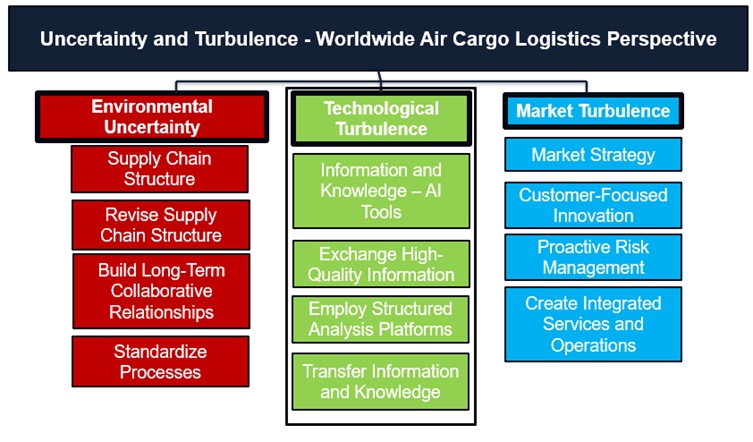
Adapted from J. Schonberger and K. Sundtoff Hald, March/April 2024, “Driving Supply Chain Flexibility in an Uncertain and Volatile World”, Supply Chain Management Review, Pgs. 24-31
The critical question becomes how can the worldwide air cargo logistics industry build a collaborative intelligence strategy today?
The process begins with the implementation of a structured engagement program based on trust, respect for each party’s roles, and an agreed-upon ‘meta’ (transformation) strategy for the industry. For long-term success, each participating private enterprise and public organisation must make a commitment to share gains between the companies at the highest level; not just between sales representatives and procurement officers.
The air cargo logistics intelligence strategy must be thought of as creating an industry utility that is conceptualised collaboratively by the industry to meet all the needs of the industry. There are many examples of industries such as banking, commercial construction, insurance, and oil and gas, where data and technology collaboration has formed industry utility standards and services that benefit all the members. When gleaning best practices to guide building an ‘Intelligence Digital Utility’ for the air cargo logistics industry, the following stand out:
1) Members: Early collaboration by a core group of small and large companies that represent various parts of the worldwide air cargo logistics supply chain,
2) Facilitators: A series of tailored think tanks and system workshops to fully develop AI use cases, specify problems to solve, and identify the necessary design elements,
3) Standards Alignment: A willingness to design and accept the data standards needed for interoperability and collaboration. This will be especially important in training and exploiting new AI tools,
4) Accountability: Engagement of a core team (combining industry expertise and consultants experienced in building these collaborative systems) to build a design for the digital utility, that leverages system-wide AI solutions,
5) Governance: Create an organisation that is separate from the members that can act as the unbiased coordinator and deliverer of standards and services, and
6) Quick Wins: Choose the first three use cases that will provide the most value with the least resistance or friction for delivery.
To fully realise the value of an intelligence strategy in the worldwide air cargo logistics industry, the actions necessary to move forward must begin this year. Given the increased volume of individual consignments, the complexity of supply chains, and the ever-changing rules and regulations, the employment of synthetic intelligence tools to secure supply chains is becoming a must-have enabler.
A workshop, by invitation, is planned for October 2025 hosted by SASI World and Future Point of View to start the process. The good news is that the opportunity exists to solve these issues in a manner that enhances the ability to improve this complex system of decisions, handoffs, deliveries, and reduce external impacts. At this level of complexity, improvements going forward are much better done with synthetic and machine intelligence because we have maximised human intelligence to help freight move frictionlessly.
If you are interested in participating in the workshop, please contact Charles Edwards.
About the Authors
Charles H.W. Edwards

Vice President at SASI World, Inc.
Charles Edwards focuses on training, financial modelling, and data analytics. His 50+ year career includes international freight forwarding in Canada and the UAE, creating and operating UPS Airlines, airport management, introducing a composite baggage container, team leader which designed and built one of the world’s largest air vehicles, spans ocean freight, rail management, and economic development.
Edwards holds degrees from universities in Canada, England, and the United States, is on the faculty of the UNC at Chapel Hill and is a Scholar Fellow of Sigma Chi Mu Tau international supply chain society. He serves on boards and committees in freight transport research and logistics education.
charles.edwards@sasiworld.com
Hart Brown

CEO at Future Point of View
Hart Brown is a world-renowned expert on simplifying complex strategies while implementing them in creative and innovative ways during crisis events.
Hart has provided services in over 50 countries to heads of state and executives during the turbulence of government transitions, one of the largest US bankruptcies, major events including the World Cup and the Olympics, and terrorism incidents.
He has been referenced in over 90 publications and news outlets such as Reuters, and is co-author of “Online and Under Attack: What Every Business Needs to Know to Manage Cyber Risk and Win its Cyber War”.
hartbrown@fpov.com